
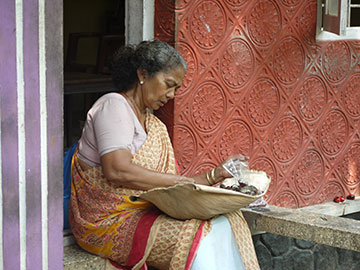
 My seventy-year-old mother-in-law makes a mean fish curry that can satiate the taste buds like no other. With hints of black Kokum and Kashmiri red chili powder, she cooks it in a clay pot over a burning wood fire. This is how many people make it, but hers is way more fiery! She grows her own peppercorn, cooks with coconut oil harvested from her own trees, and she just can’t eat a meal without a little fish on the side.
Her food is simple village fare, prepared without fuss but always in a hurry. Her husband, a military man, is very timely about his meals. She curses him out under her breath as she juggles between browning the thinly sliced coconut for the beef stir-fry (ularthiyathu) on the gas stove and adding dried twigs to fuel the fire on a traditional aduppu (fire stove), 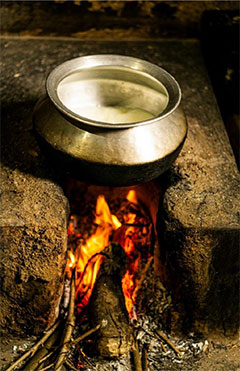 for the hour-long hard boiling required to cook the red parboiled rice, typical of Kerala. She prefers to spend most of her days within the confines of her home and the large garden surrounding it, except Sundays. Sundays are reserved for God, when she visits the local Syrian Jacobite church.
While she cooks, I cautiously stand nearby, quietly slipping into my role of the observant assistant, dicing onions or grating coconut. I look every so often over my shoulder to see what she is doing next, trying to commit to memory that particular mix of spices, till I can get to my notebook. Wrangling a recipe from her comes with the risk of revealing my own ignorance and eliciting didactic instructions! I love her but from a distance. Her approval of me, a city girl with mixed up cultural identities, is capricious. And of course, I was resigned to always be the daughter-in-law, never the daughter.
For women in my mother-in-law’s generation, cooking comprised a large part of honoring the marriage contract. It embodied the fundamental role of the housewife. Every single day of her married life, she has served breakfast, lunch and dinner on the table. Till date she plays her role with efficiency and conscious frugality. All kitchen scraps are composted and the rare container from a store bought item is reused for storage. She saves and uses fabric cut up from old sarees and bedclothes for potholders and kitchen towels. Wasting is considered abhorrent and she uses everything beyond its intended life and then some.
Throughout the day her words are peppered with virtues of faith and righteousness which could be taken with a grain of salt. Any hint of pride or arrogance is quickly dismissed with an apt quote from the Bible. She often reminds us of keeping our egos in check and to be thankful for the abilities and fortunes we receive from Him. Despite my agnostic leanings, I nod in agreement, lest I draw wrath, hers or that of a higher being.
I remember the first lunch I had there. It was not very different from the one I had the next day or the ones over subsequent days. It was always the same parboiled rice – a pearly short grain with tiny red stripes, a satisfying curry made with lentils, or meat, or yoghurt and toothsome vegetables sautéed with spices and coconut. She uses curry leaves, garlic, green chilies and coconut in just about everything. And there is always a side of fish- fried or in curry. Sometimes, with the fish curry there is tapioca, a mild flavored root vegetable with a rugged, thick brown peel and white flesh inside, peeled and boiled with salt. Every meal ends with a choice of a variety of bananas, home grown as well.
When I’m in my own home, I crave adventure in my cooking. I experiment with ethnic and avantgarde cuisines to feed my indulgences. I am fickle, never wanting to eat similar foods the next day but when I am here, I do. There is comfort in its predictability and no doubts in its genesis; people have been eating this way for generations.
Over the years my mother-in-law has planted a variety of trees such as jackfruit, plantain, mangoes, sapodilla and rambutan. Today these large trees shelter the house under their shady canopy. During season, the fruits get hauled in by the sacksful and she cuts them up for midday snacks for everyone. Pazham pori (banana fritters) is a highly favored local snack. It is made from ripe plantains dipped in a tempura like batter. Whole plantains are sliced in half lengthwise and dipped in a batter of plain flour, rice flour, water, salt, sugar and her own special twist – a good pinch of black sesame seeds. Then they are fried crisp in coconut oil. It is important to heat the oil to the right temperature so that the oil does not get absorbed into the battered plantains. As the golden fritters start to come out piping hot, she calls out to me lovingly, “Mole”(dear), can you bring some old newspapers to soak off the oil?” She is in a good mood because she is proud, and rightfully so, of the light pazham pori she has masterfully prepared.
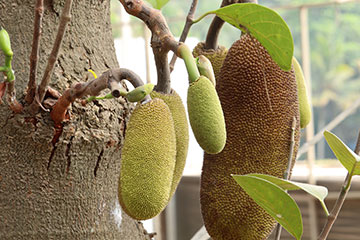
The jackfruit in its 50 pound glory is made up of hundreds of individual flowers that are fused together. The raw ones get sliced and deep fried into crunchy jackfruit chips. But the real relish is in eating it fully ripe, the fleshy petals around the seed are sweeter than honey! “Save the seeds!” she scolds when I eat the petal and toss the seed. “We can make mezhukkupuratti (sauté) with it”. She collects the walnut sized seeds in a piece of newspaper and leaves it in the sun. In a couple of days the hard white coat dries and falls off from the seed. She then sits by a window, away from the heat of the kitchen, yet close enough to keep an eye on the stray cat that might sneak in to steal the fish she has just cleaned and set aside. She starts slicing the seeds, never once using a cutting board. She holds the seed over the index finger, that is covered in a thick, orange plastic finger protector, and slices away with a crude country knife she has been using forever. Her hands are rough hewn, yet deft.
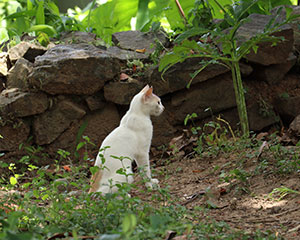 And before I know it, she is done and has already started sautéing the sliced jackfruit seeds. Realizing that I missed seeing the combination of spices she has used, I sigh and go back to setting the table for lunch.
As our time together draws to a close, I cannot wait to return to my own kitchen and rejuvenate my cooking. She and I are different, not in culture and heritage, but in the practice of it. Her practice is authentic and tenacious. Mine is experimental and organic. But for that one week every summer I emulate her steadfast style and unfaltering faith in the food she prepares for all of us.
Author: Annu Verghese